Oxford Tree-Ring Laboratory - Georgia
Georgia
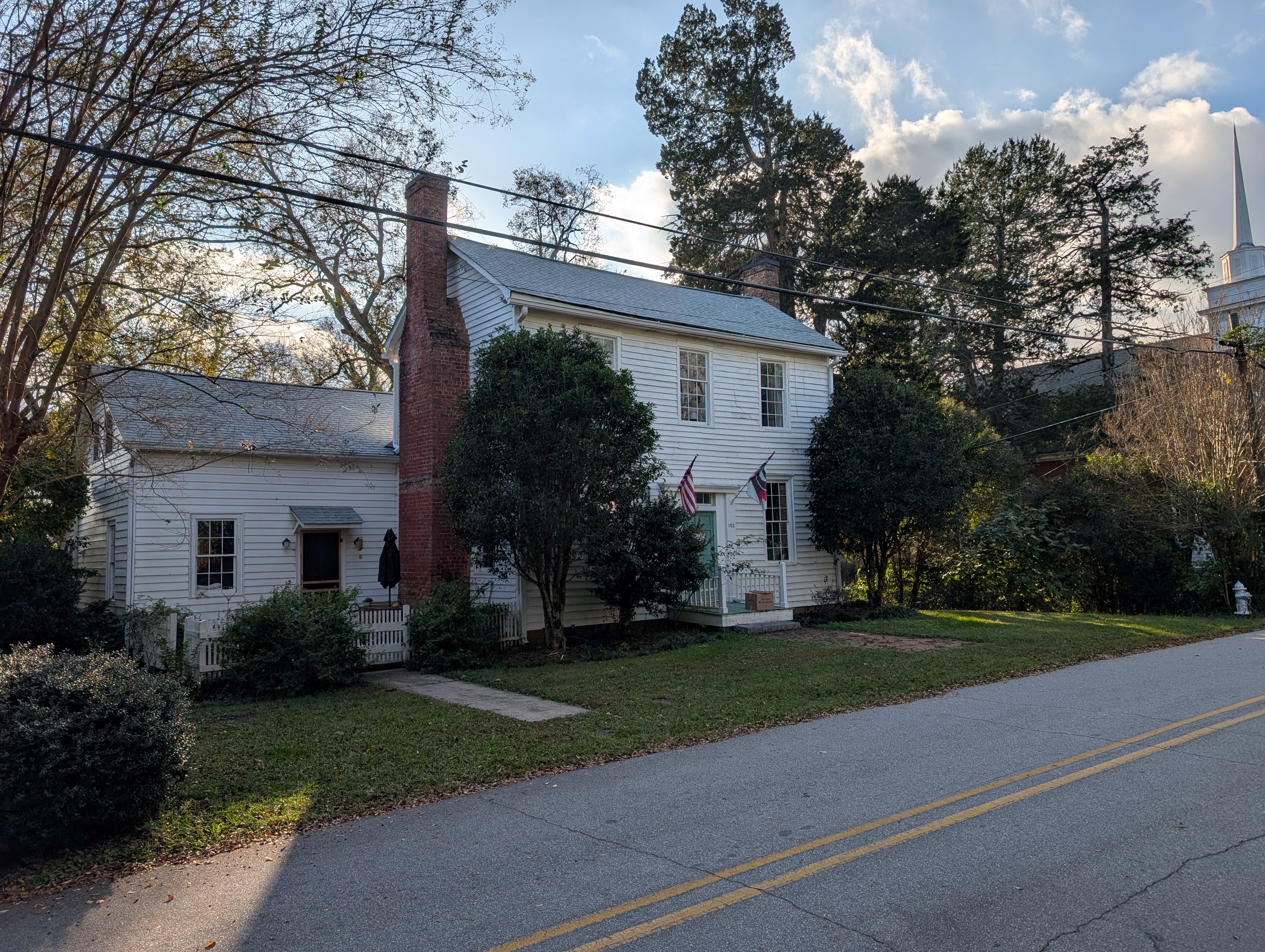
Bray House, Lexington, Georgia, (33.870495, -83.110192)
Primary Phase of House Felling Dates: Winter 1819/20
Individual sample 1751-1819 (yellow pine) poga2 (t = 5.59 IHS8; 5.51 NC09; 5.25 ncps3).
The Bray House, also sometime known as the Post-Office House, at 130 East Church Street in Lexington, was built in the early nineteenth century, with a date on which deeds and dendrochronology agree perfectly. It is two stories tall, has a hall-parlor plan, and a three-bay symmetrical façade. It was apparently built by the carpenter/joiner William P. Tripplett, who presumably did the carpentry and its fine interior woodwork. Thus, it serves as a rare example of an artisan’s town home. The large lot also apparently held his joiner’s shop, in which he employed enslaved workers along with several free whites, some of them not yet naturalized citizens. (Mark Reinberger)
Dendrochronological analysis has shown that amongst the timbers used to construct the building was one with complete sapwood that provided a felling date of the winter of 1819/20.
Worthington, M J and Seiter, J I 2025 “The Tree-Ring Dating of the Bray House, Lexington, Georgia” Oxford Tree-Ring Laboratory Report 2025/30
Oxford
Tree-Ring
Laboratory
The Oxford Tree-Ring Laboratory provides cutting-edge commercial dendrochronological services to homeowners, architectural historians, and cultural resource managers. READ MORE
Contact Information
Oxford Tree-Ring Laboratory
ProprietorsMichael Worthington
Jane Seiter, Ph.D
25 E. Montgomery St.
Baltimore, MD 21230
410-929-1520