Oxford Tree-Ring Laboratory - Georgia
Georgia
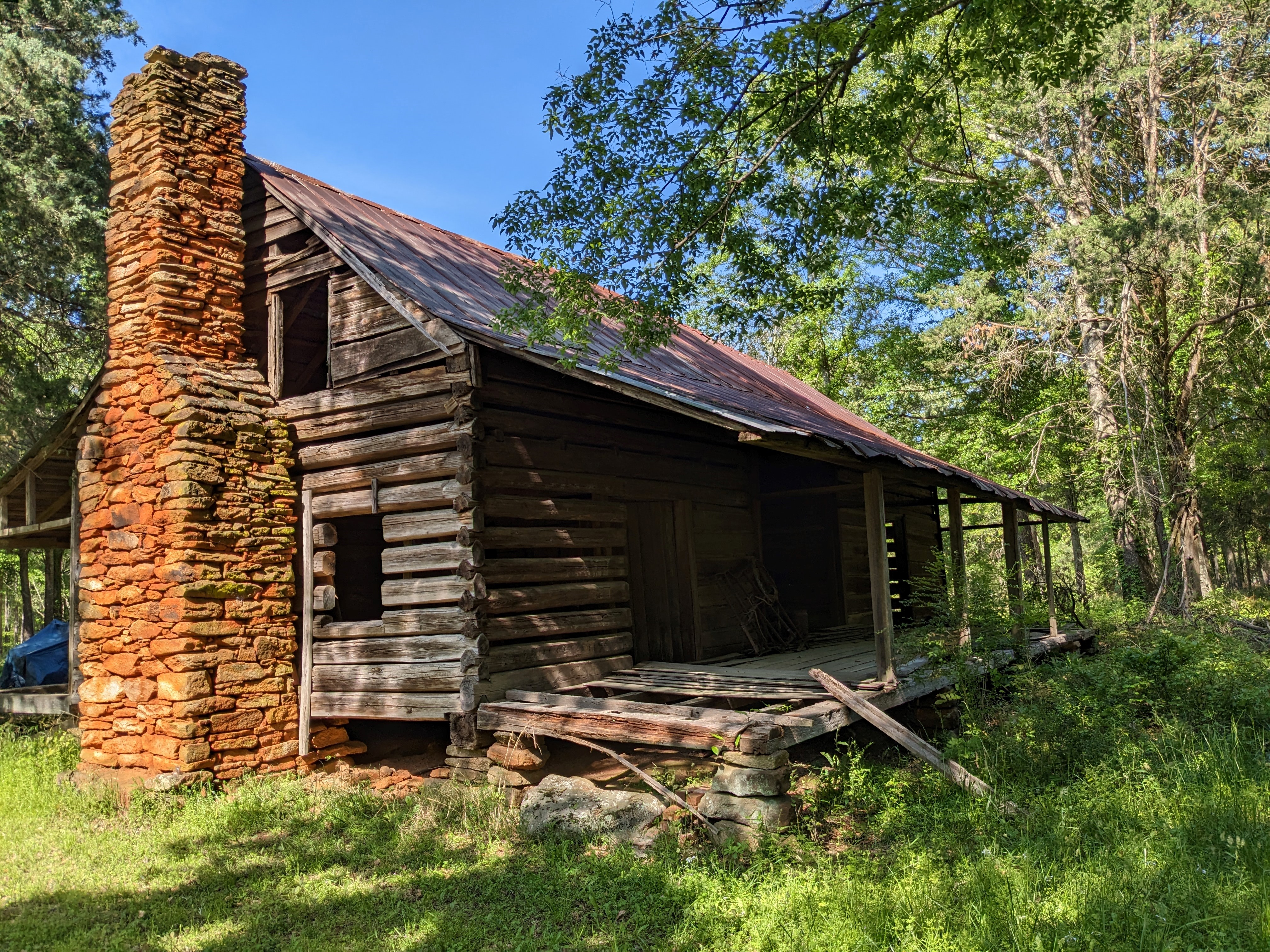
Saunders-Archer Log Dogtrot, Sparta, Georgia (33.218491, -82.896488)
Primary Log House Felling Dates: Winter 1843/4
Reused Timbers Felling Dates: Winter 1851/2
Site Master 1748-1851 (yellow pine) CPGAx2 (t = 7.17 GEORGIA2; 6.80 TCNCx1; 6.73 AL003).
The Saunders-Archer Log Dogtrot House was built by Lovett Saunders, a middling farmer in Georgia’s Hanock County, a large county and one of the most productive for cotton in the antebellum period. The Saunders family came from North Carolina to Georgia in the early 1800s, and Lovett married Martha Barksdale, of a family that had considerable land in the county. The house now stands isolated in a field back from Georgia Route 15 about five miles south of the county seat, Sparta.
The house’s dogtrot form—two log pens each 16 by 18 feet linked by a 9-feet wide “trot” open front and back, with continuous front and rear porches, all covered by a broad gable roof originally covered with wood shingles—was becoming increasingly common for middling yeoman houses in the antebellum rural south, as it was easy to build in log with its separate pens and well adapted to a hot and humid environment. The type apparently arose in the region sometime in the early nineteenth century. The earliest firmly dated dogtrots were built in 1819 in Georgia, one in Morgan County [the Henry Lane Log Dogtrot (Worthington and Seiter 2025/25)] and the other in then Cherokee country in the state’s northwest quadrant [the John Ross House (DeWeese et al. 2012)] though possibly earlier ones stand in Tennessee, often thought of as the origin of the form.
The house is very simple in execution, as most dogtrots are. Logs are notched together at the corners with V-notches, a fairly easy form that might have been executed by the owner himself or by only slightly-trained enslaved carpenters. Logs are exposed inside and out, with rough planks inside nailed over the gaps between the logs. The only finish on logs or the log joists and floor boards above is whitewash. Stone chimneys stand (or stood) against both end walls. Attic lofts lie over both pens, unconnected because the trot’s ceiling reaches to the underside of the roof. Trim is minimal; doors are board-and-batten. The house is in fairly good condition, given the long time it has stood empty, and the current owners are restoring it to its original form.
Dendrochronological analysis has shown that amongst the timbers used to construct the primary phase of the building was one with complete sapwood that provided a felling date of the winter of 1843/4, while three reused timbers from a repair phase retained complete sapwood that provided felling dates of the winter of 1851/2.
Worthington, M J and Seiter, J I 2025 “The Tree-Ring Dating of the Saunders-Archer Log Dogtrot, Sparta, Georgia” Oxford Tree-Ring Laboratory Report 2025/31
Oxford
Tree-Ring
Laboratory
The Oxford Tree-Ring Laboratory provides cutting-edge commercial dendrochronological services to homeowners, architectural historians, and cultural resource managers. READ MORE
Contact Information
Oxford Tree-Ring Laboratory
ProprietorsMichael Worthington
Jane Seiter, Ph.D
25 E. Montgomery St.
Baltimore, MD 21230
410-929-1520